Inside Wawel Castle, the State Rooms, Royal Private Apartments, Crown Treasury and Armoury show how Polish kings lived and ruled. Each is a separate exhibition with its own ticket.
Quick facts
- Highlights: Flemish tapestries, carved heads ceiling, coronation sword
- Tickets: separate per exhibition, with timed entry
- Time needed: 1 to 3 hours
- Tip: book online in high season
State Rooms
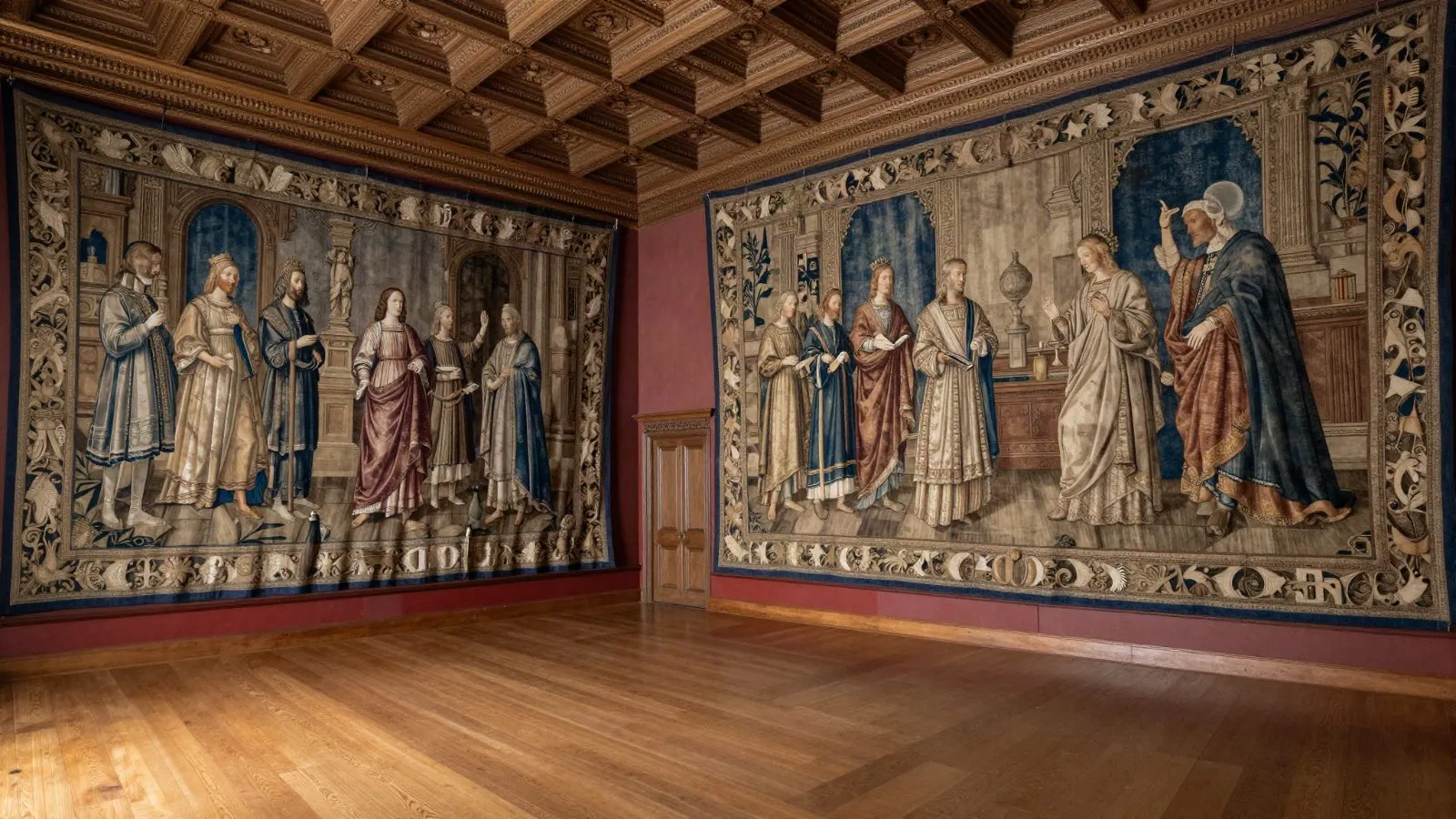
The Renaissance State Rooms were used for royal ceremonies and assemblies. Their walls are hung with the famous Flemish tapestries commissioned by King Sigismund Augustus in the 16th century. In the Envoys’ Hall, look up at the coffered ceiling decorated with carved wooden heads, the so-called Wawel heads, each with its own expression.
Royal Private Apartments
These rooms show how kings lived day to day, with period furniture, paintings and more tapestries. Entry is usually in smaller groups, sometimes with a guide.
Crown Treasury and Armoury
In the Gothic part of the castle, the Treasury displays royal regalia and treasures, including the Szczerbiec, the coronation sword of Polish kings. The Armoury shows weapons, armour and trophies from Poland’s wars, including Ottoman pieces from the 17th century.
Tickets
Wawel has several separate exhibitions, each with timed tickets and limited daily numbers. Buy online or at the visitor centre, and check which routes are open on the day. Read our detailed Wawel Castle tickets guide.
Tips
- Choose two or three exhibitions rather than all of them.
- Large bags are not allowed; use the cloakroom.
- Combine with Wawel Cathedral and the Dragon’s Den.
- Arrive early in summer to avoid queues.
Learn the background in our short history of Krakow.
Frequently asked questions
What are the Wawel State Rooms?
The ceremonial Renaissance rooms of Wawel Castle, famous for their Flemish tapestries and the carved heads ceiling.
Do I need separate tickets for each Wawel exhibition?
Yes. The State Rooms, Private Apartments, Treasury and Armoury and other routes are ticketed separately.
What is the Szczerbiec?
The coronation sword of Polish kings, displayed in the Crown Treasury.