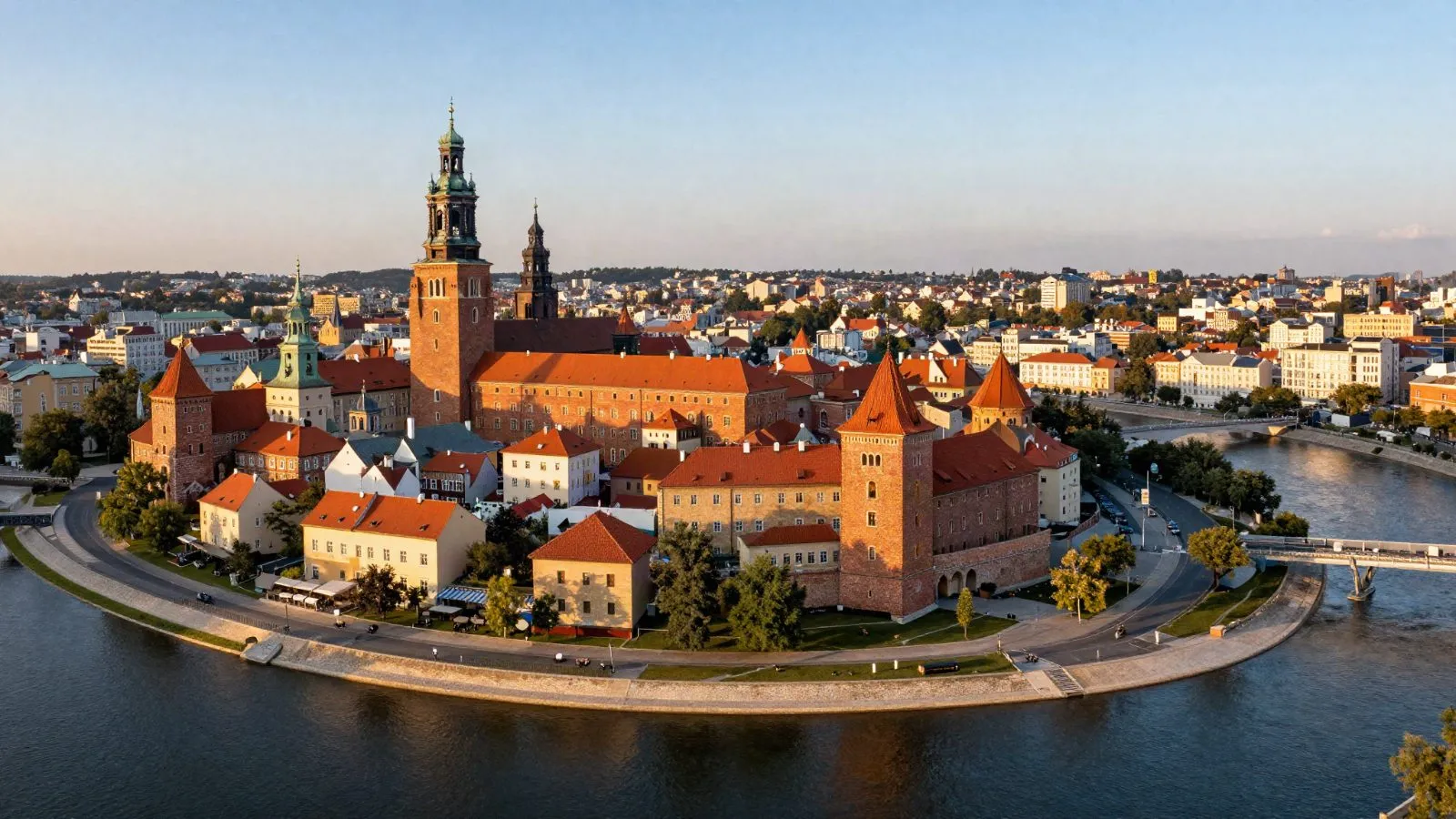
Krakow was Poland’s royal capital for centuries and survived World War II largely intact. This short history will make every walk around the city more meaningful.
Quick facts
- Town charter: 1257
- Jagiellonian University founded: 1364
- Royal capital: until around 1600
- UNESCO listing: 1978
Legends and beginnings
Legend says Krakow was founded by Prince Krak, who built his castle on Wawel Hill after a clever shoemaker defeated the dragon in the cave below. Read the story in Krakow legends. In reality, Wawel was a settlement long before the first written mentions in the 10th century, and a bishopric was founded here around the year 1000.
Medieval capital
After a devastating Mongol raid in 1241, Krakow was rebuilt and received its town charter in 1257. The grid of streets around the Main Market Square dates from that time. In 1364 King Casimir the Great founded the university, today’s Jagiellonian University; its oldest building is Collegium Maius.
The Golden Age
Under the Jagiellonian dynasty in the 15th and 16th centuries, Krakow flourished as a centre of trade, science and art. Nicolaus Copernicus studied here, the Renaissance courtyard of Wawel Castle was built and the Cloth Hall got its elegant attic. Kings were crowned and buried in Wawel Cathedral.
Losing the capital
Around 1600 King Sigismund III moved the court to Warsaw, though coronations continued in Krakow. Wars and the 18th-century partitions of Poland followed. Krakow became part of Austria, was briefly a Free City in the early 19th century and later enjoyed relative autonomy as part of Austrian Galicia, which made it a centre of Polish culture.
World War II
Poland regained independence in 1918. In 1939 German forces occupied Krakow and made it the seat of the General Government. The Jewish community, centred in Kazimierz, was forced into the ghetto in Podgórze and almost entirely murdered in the Holocaust, many at nearby camps including Auschwitz-Birkenau. Learn more at Schindler’s Factory. The city’s buildings survived largely intact.
Communism
After 1945 Poland became a communist state. The regime built the industrial town of Nowa Huta on Krakow’s edge. In 1978 the historic centre joined UNESCO’s first World Heritage list, and the same year Krakow’s archbishop Karol Wojtyła became Pope John Paul II; see John Paul II’s Krakow.
Krakow today
Since the fall of communism in 1989 and EU membership in 2004, Krakow has become one of Europe’s most visited cities, with a big student population, a lively cultural scene and a booming tech sector. Explore more in our Krakow travel guide.
Frequently asked questions
Was Krakow the capital of Poland?
Yes, Krakow was the royal capital for centuries until the court moved to Warsaw around 1600.
Was Krakow destroyed in World War II?
No. Unlike Warsaw, Krakow’s historic buildings survived the war largely intact.
When was Krakow founded?
Wawel Hill was settled long before written records. Krakow received its town charter in 1257.